
The first winter I owned a property I couldn’t drive to, a guest messaged me at 8:52 PM to say the heat had stopped working. It was the kind of cold where you start thinking about pipes.
I was in a different time zone with a laptop and a phone. My cleaner had gone home two hours earlier and lived forty minutes away. I had no handyman on file for that market, because I’d never needed one — at my first two properties, the handyman was me. I spent thirty-five minutes calling 24-hour HVAC companies, none of whom would commit to a truck before morning, while a family sat in a cold house.
The actual problem was a tripped breaker. It took one more phone call and a guest willing to open a utility closet, and it was fixed in under two minutes.
That’s the part that has stuck with me. It was never a hard problem. It was a ten-minute problem that needed a person in the room, and I had spent zero effort making sure a person could be in the room. Remote hosting doesn’t fail on the big stuff — you’ll find a roofer for a roof. It fails on the trivial stuff that only a body can solve.
The Constraint Isn’t Distance, It’s Who Can Get There
When you host a property you live near, you are the fallback for everything. Cleaner cancels — you clean. Lock dies — you drive over with the key. Guest can’t find the trash cans — you walk out and point.
You almost never notice how much that absorbs, because it never shows up as a task. It shows up as a Saturday.
Move one state away and every one of those silent absorbencies becomes an open question with a name attached. The job stops being “do the work” and becomes “make sure the right person is dispatched, informed, and paid.” That reframing is the whole difference, and it’s why the tooling that matters for out-of-state hosts is not the tooling that matters for local ones.
Three things change at once:
- Every physical problem needs a person who isn’t you, which means the bench matters more than the software
- You lose ambient information — you never notice the porch light is out, because you never see the porch
- Your response time becomes a scheduling problem, not a willingness problem. You can want to help at 11 PM and still be useless.
The test for whether you’re actually set up to host remotely: something breaks at 9 PM on a Sunday and you can name the person who will handle it, reach them, and authorize them to spend money — all without a guest waiting on your next reply.
The rest of this is how I got to a yes on that question across three properties I don’t live near.
Build the Bench Before You Need It
The most common out-of-state hosting mistake is treating your local team as something you assemble reactively. You cannot recruit a plumber during an emergency; you can only accept whoever answers the phone, at whatever they want to charge.
Build it while nothing is wrong. For each property, I want these roles filled with a name, a number, and a prior interaction before I take a booking:
| Role | What they cover | How I find them |
|---|---|---|
| Primary cleaner | Turnovers, restocking, eyes on the property | Referral from another host in the market |
| Backup cleaner | The primary’s flu, vacation, and no-shows | Hire for one deep clean before you need them |
| General handyman | The 80% of problems that aren’t a trade job | The cleaner almost always knows one |
| Licensed trades | HVAC, plumbing, electrical | Call in the off-season and ask about after-hours policy |
| Someone who lives nearby | Storm checks, a package, a lockout of last resort | Neighbor, friend of the cleaner, another host |
That last row is the one people skip and the one that saved me the most. It is not a job — it’s a relationship, and it should be paid when used. A neighbor willing to walk over and confirm the water is off is worth more at 10 PM than any subscription.
One practical note on the backup cleaner: do not leave them theoretical. Pay them for a real clean, once, while your primary is on vacation. A backup you’ve never worked with is a phone number, not a plan. The first time you use them shouldn’t be the morning of a same-day turnover.
Cleaning Coordination Is Most of the Job
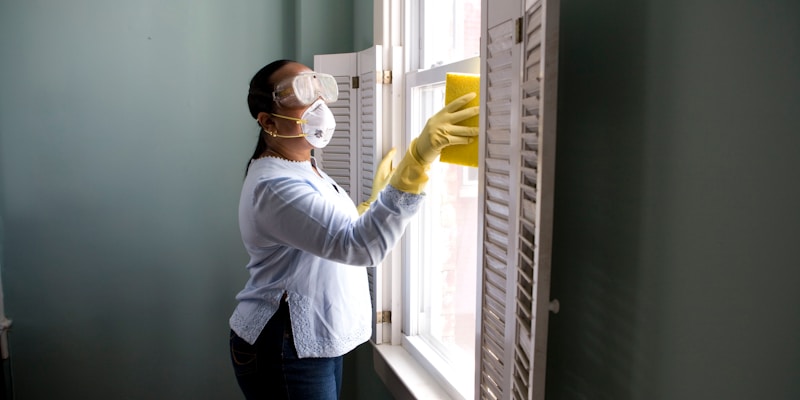
When you host locally, cleaning is a chore. When you host remotely, cleaning is your entire quality-control apparatus. Your cleaner is the only person who reliably sees the inside of the property, which means they aren’t just cleaning — they’re your inspector, your restocking supply line, and your early-warning system for maintenance.
Treat the role that way and two things follow.
First, the schedule has to come off the calendar, not out of a text thread. Coordinating turnovers by text works at one property and degrades fast after that. The failure isn’t dramatic; it’s a cleaning that was never confirmed, on a checkout you forgot was a same-day, discovered when a guest walks into an unmade bed. I’ve written up the mechanics of getting off texts in the cleaner scheduling guide — the short version is that a turnover should be created by the booking, not by you remembering the booking.
That is exactly the piece I stopped doing by hand. Outkeepr reads the reservations off Airbnb and VRBO and puts a cleaning on the right date for the right property, assigned to the right cleaner, without me touching the calendar — and the cleaner accepts or declines it in their own app. From two time zones away, the thing I care about is not that the schedule exists, but that a human being has visibly accepted each job. A declined cleaning I can see on Tuesday is a problem. A cleaning nobody ever acknowledged is a disaster on Friday.
Second, the cleaner needs standing authority. If your cleaner has to text you to ask whether to replace a broken lamp, you have built a system where every small decision waits on a phone in a different time zone. Give them a written spend limit they can use without asking, a list of things they should just handle, and a promise of same-day reimbursement. The point isn’t the money. It’s that a guest arriving at 4 PM doesn’t need the lamp to route through you first.
Pay them properly for the expanded role, too. A remote host’s cleaner is doing inspection work, and inspection work is worth paying for.
Key Handoff When Nobody Can Meet the Guest
The out-of-state constraint kills every access method that assumes a person will be present. That narrows the field usefully.
| Handoff method | Works remotely? | The failure mode |
|---|---|---|
| Meeting the guest | No | Requires you, or someone paid to wait around |
| Lockbox with a shared code | Barely | Code never changes; every past guest still has it |
| Smart lock, codes set by hand | Yes, at 1–2 properties | You, awake, setting codes per booking |
| Smart lock, codes off the booking | Yes | Battery and connectivity — both solvable |
| Physical credential (fob, transponder) | No | Cannot be transmitted; must live in the unit |
The destination is a lock with per-booking codes that activate at check-in and expire at checkout, which I’ve covered in depth in the smart lock setup guide. What changes when you’re remote is the failure planning around it, because you can no longer be the backup.
Three things I insist on now:
- A physical backup key in a real lockbox, whose code I can give a guest over the phone and change afterwards. A dead lock battery at 11 PM is not an emergency if a key exists.
- A cleaner code on a recurring schedule, separate from guest codes. Your cleaner should never need a guest’s code, and you should never be woken up to grant access on a turnover morning.
- Batteries replaced on a calendar, not on a warning. The low-battery notification arrives when you’re 900 miles away and can’t act on it. My cleaner swaps them quarterly whether they need it or not.
The code delivery is where remote hosting quietly breaks. A code that’s correct in your lock but never reached the guest — because you were asleep when the booking came in — produces the same 9 PM phone call as no code at all. Having the arrival message go out on its own schedule, with the actual code for the actual reservation in it, is the difference between a system and a habit. That, plus solid check-in instructions written for someone arriving in the dark, is most of what self check-in actually requires.

Inspecting a Property You Can’t Walk Into
Here’s the uncomfortable truth about out-of-state hosting: you will find out your property has degraded from a review. Slowly worsening things — a stained duvet, a wobbling chair, a shower head with mineral buildup — never generate an alert. Nobody reports them. They just quietly lower your ratings.
The fix is to make somebody else’s eyes systematically yours.
- Photos every turnover, not just when something’s wrong. A short standard set — each bed made, bathroom, kitchen counters, living area — takes a cleaner ninety seconds and gives you a dated visual record of the property’s condition.
- A named list of things to flag, not a vague “let me know if anything’s off.” Wear items are invisible to someone who sees them every week unless you name them.
- A consumables count on every clean, so restocking is data instead of a memory.
- One in-person visit a quarter, minimum. Nothing replaces standing in the room. Book it as a stay; you’ll find six things in an hour.
The reason the photo habit works is that the photos come back attached to a specific turnover, so I can scroll back and see when a thing started. In Outkeepr the cleaner’s checkout photos land on that cleaning itself, which means “when did that headboard get scuffed” is a question I can actually answer instead of guess at. Photos in a text thread are useless six weeks later; photos attached to a date are an inspection record.
What I look for in the photo set isn’t cleanliness. It’s change. The clean is binary and the cleaner already knows how to do it. What I’m scanning for is what looks different from the last set — that’s the thing nobody is going to report.
The 9 PM Problem
Every remote host eventually confronts the same question: what happens between the guest’s message and your next available moment?
You can’t be always-on. Trying is how hosting stops being worth doing. What you can do is make the gap boring:
- Guests should never be routed to a number that might not answer. Answer in the platform thread, where the whole history lives.
- Have a written escalation path per property. Category of problem → who to call → their hours → their spend authority.
- Decide in advance what a guest is authorized to do themselves. Where the breaker panel is. Where the water shutoff is. Which drawer holds the fuses. My cold-house night would have been nine minutes long if a labeled panel photo had been in the house manual.
- Route the routine messages away from yourself entirely so the ones that actually need you stand out.
That last point is the one that makes the rest survivable. The overwhelming majority of after-hours guest messages are questions with fixed answers — Wi-Fi, parking, checkout time, the trash day. When those consume your evening attention, the one message that’s actually a burst pipe gets the same weight as “where’s the coffee filters.” Getting the routine questions answered automatically is genuinely the difference between hosting remotely and being on call forever, which is why I let Outkeepr answer from the property’s own details and only surface the threads that need a human decision. There’s more on drawing that line in the guest messaging automation guide.
Supplies, and the Things That Run Out
A local host restocks by noticing. A remote host restocks by system, or runs out of toilet paper on a holiday weekend.
What works for me is par levels: a written minimum quantity for every consumable, stored in the unit, checked on every turnover. Below par, it goes on the list. The cleaner either buys it against their standing spend authority or I ship it, and everything ships to the property rather than to me.
The three that bite hardest, in my experience, are coffee, trash bags, and light bulbs — they’re cheap, invisible until missing, and each one reliably generates a guest message. Keep an overflow closet with a lock on it, and the whole category stops being a category.
Three Ways to Staff a Remote Property
There are really only three shapes this takes, and hosts tend to pick one by default rather than deliberately.
| Approach | What you give up | Where it breaks |
|---|---|---|
| Full-service property manager | A share of revenue, plus control over guest experience | Their incentives are occupancy; yours are margin and reviews |
| Local co-host | A negotiated cut, and dependence on one person | It’s one person. Vacations, burnout, moving away |
| Systems plus contractors | Setup time up front | Nothing gets done that you didn’t design a path for |
I run the third one. Not because managers are bad — a good one is genuinely valuable, especially at one property in a market you’ll never visit — but because the percentage models stop making sense as the portfolio grows, and because the thing they’re mostly selling is coordination, which is the part software actually does well.
If you go that route, be honest that the setup cost is real. You’re building a bench and writing down procedures that live nowhere but your head right now. The upside is that it’s the only one of the three that gets cheaper per property as you add properties. Outkeepr is priced for that shape deliberately — $5 per property per month plus 0.5% per booking, with a 14-day trial — so adding a fourth property is an incremental line item rather than a renegotiation.
The Sunday Routine
Remote hosting is mostly maintained by one short weekly pass. Mine takes about twenty minutes:
- Look at next week’s calendar across every platform — specifically for same-day turnovers and gap nights, which are where cleaning schedules break
- Confirm every turnover has an accepted cleaning with a named person, not a scheduled one nobody acknowledged
- Skim the last week of checkout photos for change, not cleanliness
- Read any flagged maintenance item and either dispatch it or decide it’s cosmetic
- Check consumables against par and put in an order if anything’s short
- Verify one credential on rotation — a gate code, a lock battery, a Wi-Fi password
That’s it. If the week is clean, this is twenty minutes. If something’s wrong, you find it on a Sunday afternoon with days of runway rather than on a Friday night with a guest in the driveway.
The point of running remotely isn’t that nothing goes wrong. It’s that when something does, there’s a person closer than you who can fix it, they’re already authorized to, and you find out early enough that the guest never does.
Back to the Cold House
The night the heat went out, I had every ingredient of a functional remote operation except the one that mattered: nobody within an hour of the property who could walk in and look at a panel.
I have that now — a handyman I’ve paid enough times that he answers, a cleaner with a spend limit and a key, and a neighbor two doors down who has my number and gets paid when I use it. The tooling underneath it is genuinely secondary to those three relationships. What software buys you is that the dispatch, the codes, the schedule, and the routine guest questions happen without you being awake for them, which is what preserves your attention for the problems that actually need a human on the ground.
If you’re hosting a property you can’t drive to, start with the bench. Then automate everything that stands between a problem and the person who can fix it.
Outkeepr handles the coordination layer — reading your bookings, scheduling and assigning the turnovers, keeping access and arrival messages moving, and putting checkout photos where you can actually find them later. Download the app and set up your first property; the 14-day trial is more than enough time to see whether a full turnover cycle runs without you touching it.
Ready to automate your vacation rental?
AI guest messaging, smart lock codes, cleaner scheduling, and more — starting at $5/mo per property.
Try Outkeepr Free